
From time to time, every business faces the same quiet problem: demand that doesn’t fit. A real estate agency receives insurance questions. A travel company is asked about local services. A retailer gets logistics inquiries it cannot handle. These moments rarely feel strategic. Most of the time, they are simply ignored. And that’s where revenue quietly disappears.
Today’s customer expectations make this even more critical. Research shows that up to 53% of users abandon a request if they don’t receive a response within two minutes. In other words, it’s about responding fast, even when the request falls outside your core offering. This is where referral ecosystems change the game.
Instead of losing these requests, companies can redirect them to trusted partners through structured networks where each participant benefits. What used to be “not our business” becomes “still our opportunity.”
Let’s take a simple example. A mid-sized travel company receives frequent requests from customers asking for airport transfers, local guides, or even insurance. Traditionally, their support team would respond with something like: “Sorry, we don’t provide this service.” End of interaction.
Now imagine a different scenario. The same request is automatically routed to a trusted local partner: a transportation provider or insurance company. The customer gets a fast, relevant solution. The partner gains a qualified lead. And the travel company earns a referral fee or strengthens its partner ecosystem.
Another example comes from e-commerce. A retailer selling furniture often gets questions about delivery, installation, or interior design. Instead of building all these capabilities internally, they can connect with logistics providers and design consultants. Each redirected request becomes an additional revenue stream without increasing operational complexity.
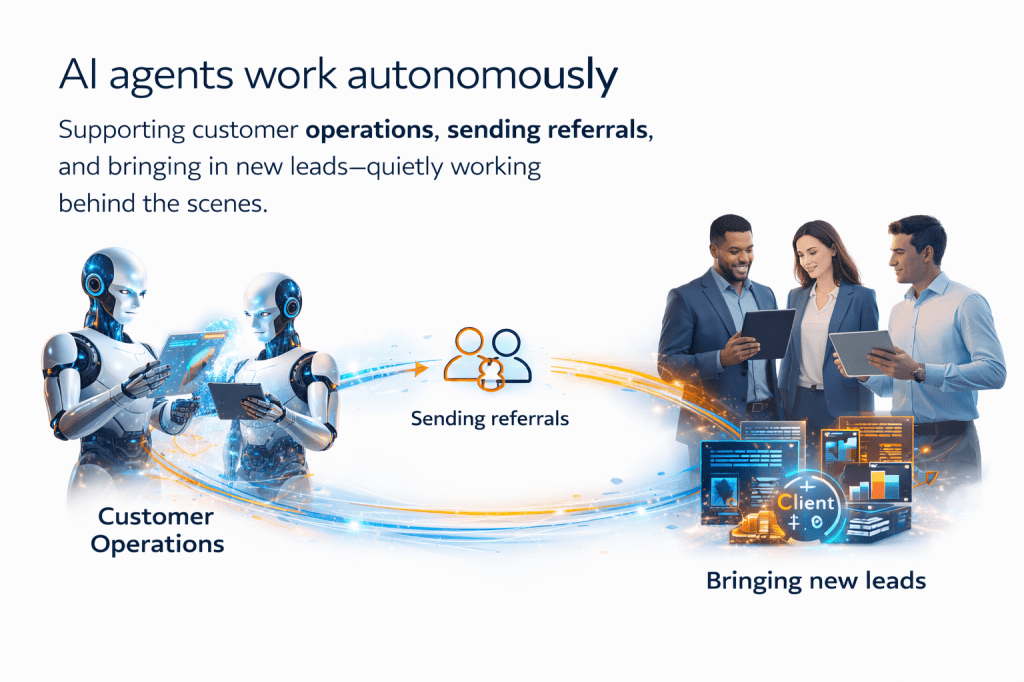
This is where AI agents bring real leverage. AI is not just about automation for its own sake. It becomes powerful when applied to these small, high-frequency decisions. An AI agent can instantly analyze incoming requests, understand intent, and decide:
- Can we serve this internally?
- Should it be redirected?
- Which partner is the best match?
And all of this happens in seconds, without human involvement. The result is a system that works continuously in the background:
- Faster response times (critical for customer retention)
- Reduced manual workload for support and sales teams
- Higher customer satisfaction, because every request gets a meaningful answer
- New revenue streams from redirected demand
What’s interesting is that this is not about adding complexity. It’s the opposite. Companies stop trying to do everything themselves and instead become part of a network where value flows between participants.
In a way, AI agents act as intelligent connectors inside that network. They don’t just automate tasks, but make decisions at scale. At this point the real shift happens.
Customer experience is no longer defined only by what your company can do. It is defined by how well you can respond, even when the answer lies outside your own capabilities. The companies that understand this early will not just serve their customers better. They will capture demand that others continue to lose.
 BD&C - Business Development & Consulting
Leave a comment