
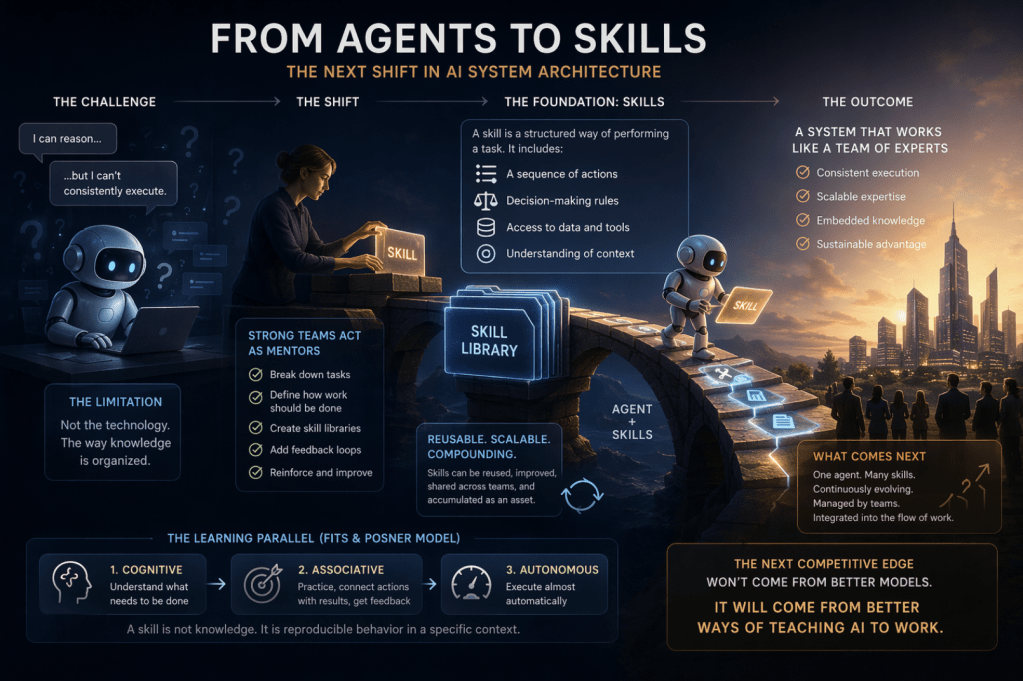
These days I see more and more publications about shifts in AI system architecture, and this is certainly not accidental. At the beginning of the year, some of my contacts proudly shared that they had introduced AI assistants into development, automated parts of their processes, accelerated delivery, and everything looked exactly as expected: faster code, faster responses, faster experiments. But now they are sending different messages, saying that, well, the speed has increased, but the result turned out… not so great.
The reason turned out to be quite simple: AI started to work as an amplifier, but it amplified not only the strengths of the system, but also its weaknesses, and now the main question is to understand where the real limitation actually lies. Let’s try to figure it out.
By investing in “agents,” companies are increasingly seeing the same situation: agents can reason but cannot consistently execute work because they lack structured experience. And this means the limitation is shifting toward how knowledge is organized within the system. Agents are missing the same thing that junior specialists lack: the skills to perform specific types of tasks.
At this point, it becomes interesting, because we inevitably arrive at the concept of a skill itself. A skill is not just an instruction and not a set of steps from documentation, but a structured way of performing a task, which includes
– a sequence of actions,
– decision-making rules,
– access to the necessary data and tools, and, importantly,
– an understanding of the context in which the task makes sense.
In practice, these skills are already being implemented as structured artifacts — packages that combine instructions, logic, and resources, which agents can load when needed. When an agent receives such a skill, it stops improvising and begins to work much closer to how a specialist works. And at this moment, the logic of the system itself changes: skills can be reused, improved, transferred between teams, accumulated as an asset, and gradually it becomes obvious that we are no longer so much “developing AI” as we are managing knowledge and processes.
If we take a deeper look at this, a very precise parallel emerges with how human skills are formed. In classical psychology, for example in the model of Fitts and Posner, a skill goes through three stages: first a person understands what needs to be done, then learns through practice and mistakes, and only then reaches the level of automatic execution. At the first stage, they think through every step, at the second they begin to connect actions with results, and at the third they act almost automatically. And this is an important point: a skill is not knowledge as such, it is reproducible behavior in a specific context.
At the same time, it is important to recognize the difference. Unlike humans, AI does not “learn” these skills through repetition within a single workflow. Instead, skills are explicitly designed, structured, and reused across tasks. This makes the role of teams even more critical: the quality of execution depends not on how much the AI “practices,” but on how well the skill itself is defined.
This is exactly where it becomes clear why so many AI systems today get stuck at the level of a “smart beginner.” We give the model instructions, and this corresponds to the first stage. It may even handle individual tasks quite well, but then the main thing does not happen: there is no systematic reinforcement of results at the system level, no structured accumulation of experience, no consistent way to reproduce successful execution. Without this, automation, stability, and predictability do not fully emerge. As a result, the agent remains very capable, but still an inconsistent executor who needs to be guided again and again.
And this is where the most important shift in the approach of strong teams begins. They stop treating AI as a tool and start working with it as a system that needs to be designed and trained. This no longer looks like model configuration, but like organizing the process of skill formation: tasks are broken down into repeatable elements, it is explicitly defined how the work should be done, libraries of reusable skills are created, and feedback mechanisms are introduced to improve consistency over time. In one of our recent projects, structuring recurring workflows into reusable “skills” significantly reduced rework and made AI outputs more stable across teams. In essence, delivery teams begin to act like mentors who do not just assign tasks but shape the way those tasks are performed.
At some point, it becomes clear that this is where a new competitive advantage emerges. The difference between companies stops being a question of “who has better AI,” because access to capabilities is becoming more widespread. But the difference in who has structured knowledge, who has reproducible processes, and who has AI embedded into the system of work rather than used as a separate tool becomes critical. This is where a new point of competition appears. It is not intelligence that becomes the limitation, but the way knowledge is organized.
If we look a bit further ahead, it becomes clear where this is going. We are gradually moving toward architectures where one agent works with many skills, the skills themselves continuously evolve, and teams manage not only code, but also the “behavior” of AI within the system. And the most interesting part is that what started as experimentation is now being formalized into real approaches and standards. Right now, teams are not just exploring how to form skills for AI, but actively scaling them, refining them, and integrating them into production workflows. And with high probability, already this year we will see the next stage of market separation: not by the level of technology, but by the ability to teach AI how to work. The teams that manage to build a systematic approach to skill formation will move ahead. Because AI already knows how to do the work. The only question now is: do we know how to teach it to do it properly.


Leave a Reply