
Outreach Is No Longer About Sending Messages, It’s About Creating Entry Points Into Conversations
If you’ve run even one outreach campaign recently, you’ve probably felt the same shift: emails go unopened, LinkedIn messages sit in silence, and even well-written, personalized notes get ignored.
It’s tempting to conclude that channels are broken. I keep hearing here and there: “Our offer was not weak, but we lost those deals because nobody replied.”
At a first glance, it seems like the channels themselves have stopped working. But when you look closer, the issue isn’t the channel. It’s the way people engage with communication today.
A quiet but fundamental shift
For a long time, outreach followed a simple logic: send enough messages, and some of them will convert. That logic worked when attention was easier to capture and expectations were lower.
Today, the environment is very different. according to the Radicati Group, professionals receive more than 120 emails a day; in many B2B sectors, cold email response rates have dropped below five percent; cold calls rarely lead to meetings, and even on LinkedIn, where business conversations are expected, response rates are steadily declining.
This change reflects a deep behavioral change: due to the dramatic increase of informational noise that we have to process ever day now, people have become far more selective about where they invest their attention. They only respond to messages that feel timely, useful, or genuinely interesting.
That’s where the idea of “entry points into conversations” begins to shine. Outreach starts working again when it gives someone a reason to engage, not just a reason to read.
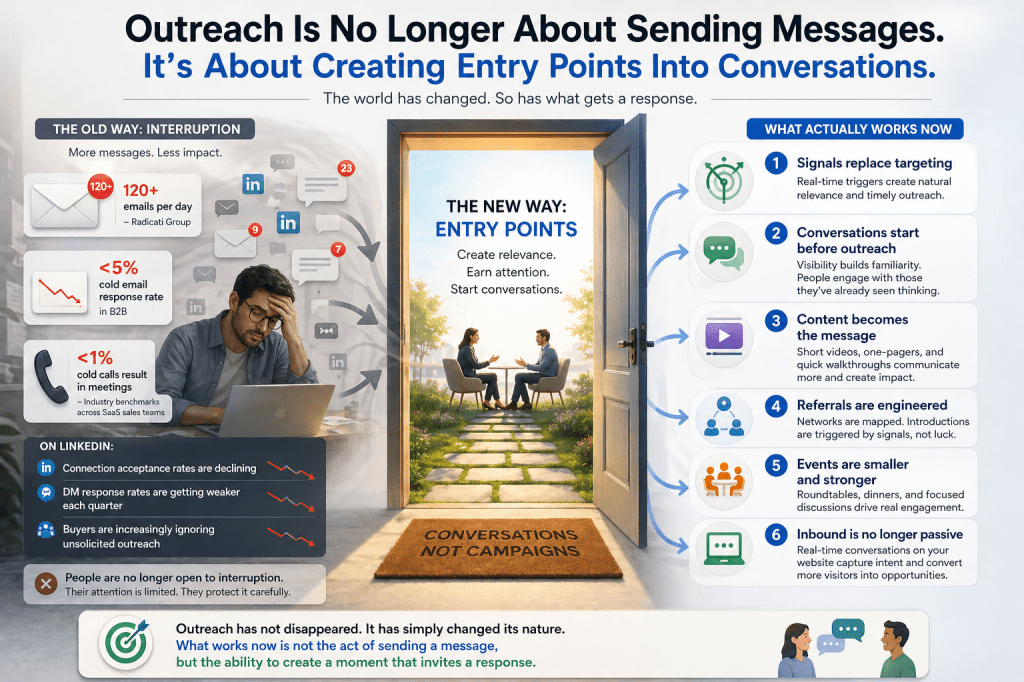
Where conversations actually begin
One of the most visible changes is the growing role of signals. Instead of building outreach around static profiles or job titles, strong teams pay attention to what is happening right now inside a company.
A hiring push in AI, a new product launch, expansion into another market, or even subtle shifts in technology stacks often reveal more than any company description. These moments create natural openings for conversation.
When outreach reflects that context, it feels less like an introduction and more like a continuation of something already in motion. A short message that connects to a real situation, such as scaling a pricing engine or integrating multiple systems, naturally resonates more than a general statement about services.
Another interesting shift is how often conversations begin long before any direct outreach happens. People tend to engage more readily with those they have already noticed somewhere else.
This is where visibility plays a quiet but powerful role. Thoughtful comments under posts, short observations shared publicly, or even a simple perspective added to an ongoing discussion can create recognition. Over time, this builds a sense of familiarity.
By the time a direct message arrives, it no longer feels like a cold approach: it comes like a continuation of a conversation that has already started in a different form.
There is also a noticeable change in how information is delivered. Long messages are becoming less effective, while short, well-structured pieces of content are gaining attention.
A brief video, a single-slide explanation, or a quick walkthrough often communicates more than a carefully written paragraph. It shows effort, it conveys clarity, and it allows the recipient to grasp the idea immediately.
In practice, a 30-second video explaining a common challenge in EV platform integration or data infrastructure scaling can open a conversation more effectively than several follow-up emails. The format itself signals that something meaningful is being shared.
So, what actually works now?
1. Signals replace targeting
Instead of asking: “Who fits our ICP?” strong teams now ask: “What just happened that makes this conversation relevant right now?”
Examples (or so-called signals):
- A company starts hiring AI engineers
- A product launches in a new market
- Infrastructure complexity begins to scale
- Regulatory pressure increases (AI, EV, fintech)
In this context, the outreach message changes completely:
Instead of: “We help companies scale development…”
You say: “I saw you’re building a real-time pricing engine. That’s usually where data pipelines start breaking under load. I recently worked on structuring something similar.”
You see? Same service, but completely different impact, because the outreach is anchored in context, not identity.
2. Conversations start before actual outreach
One of the most underused channels today is not a channel at all. It’s visibility. Here’s what I mean: people engage with those they’ve already seen thinking.
That’s why thoughtful comments, short insights, and reactions to others’ ideas are becoming powerful. A relevant comment under a post, a short take referencing someone’s idea, a perspective shared publicly before reaching out… and by the time you send a message, you are no longer a stranger! Because you already contributed to the conversation.
3. Content becomes the message
Instead of writing longer emails, top performers are doing something counterintuitive: they are sending less text and more context-rich artifacts:
- A 30-second video
- A one-slide breakdown
- A quick walkthrough of a similar case
Example: “I just recorded a quick 40-sec thought on where EV platforms usually hit scaling issues ; it might be relevant to what you’re building.”
Why this works:
- It shows effort (rare signal!)
- It compresses thinking faster than text
- It feels personal without being long
In many cases, one short video outperforms five emails.
4. Referrals are no longer “accidental”, they are engineered
Referrals have always worked, but now, they are being treated as a system, not as a strike of luck. Teams map second-degree connections, partner ecosystems, customer networks- and trigger introductions based on signals.
Instead of: “Do you know someone?” It becomes: “You’re working with companies scaling X. we’re seeing a similar pattern across your network. Would it make sense to connect us?”
This is how “network-driven pipelines” are quietly replacing linear funnels.
5. Events are getting smaller and stronger
Large conferences still exist, but high-conversion interactions are moving elsewhere. What works now:
- Small roundtables (5–8 people)
- Private dinners
- Problem-focused discussions
The outreach changes from: “Let’s schedule a call” to: “We’re bringing together a few teams dealing with X — thought you might find it useful to join.”
People avoid sales conversations. But they actively join peer conversations.
6. Inbound is no longer passive
Another major shift is happening on company websites. For years, the model was: Visitor arrives, browses, and maybe fills a form. Today, high-performing companies are doing something else:
- Visitor arrives
- Interaction starts immediately
- Context is captured in real time
- Qualification happens instantly
According to Drift, companies using conversational interfaces see up to 20–30% higher conversion rates (!) and 55% more qualified leads (!) The logic is simple: If someone already showed intent, why wait for them to reach out?
What changes in practice
All of these shifts point in the same direction: outreach becomes more effective when it aligns with context, timing, and genuine relevance.
Instead of focusing on how to reach someone, the emphasis moves toward understanding why they would want to engage at a particular moment. Instead of refining templates, attention shifts to shaping insights that offer a fresh perspective. Instead of pushing for immediate responses, the goal becomes to create conditions where a conversation can naturally begin.
At the heart of this transformation lies a simple observation: People are no longer open to being interrupted in the way they once were, their attention is limited, and they protect it carefully.
When outreach adds no new perspective, it blends into the background. When it introduces a clear, relevant idea, it stands out.
That is why the most effective outreach today often feels less like outreach at all. It feels like a useful thought shared at the right moment. And that brings us back to where we started: outreach has not disappeared, it has simply changed its nature.
What works now is not the act of sending a message, but the ability to create a moment that invites a response.


Leave a Reply