
Recently, I spoke with a technology leader who had introduced a few AI agents into his team as a small experiment. At first, it sounded like a familiar story: one agent helping with research, another assisting with writing code, maybe one more reviewing outputs. But then he said something that stayed with me: “They’ve started coordinating the work between themselves.” That was the moment when it became clear that this was no longer just automation. Something more interesting was beginning to take shape.
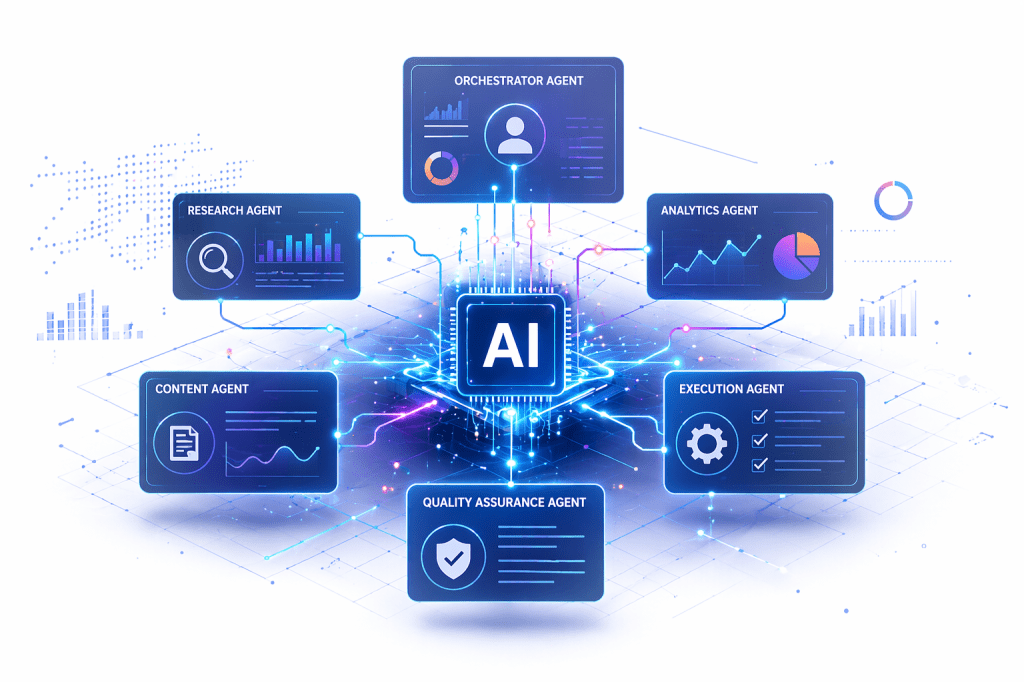
What we are seeing now is a shift from using AI as a single tool toward building systems where multiple agents work together. Instead of one model trying to do everything, companies are structuring tasks across several specialized agents. One defines the goal, another breaks it into steps, others execute those steps, and a coordinating layer keeps everything aligned. It starts to resemble a real team, except this team exists entirely inside software.
This pattern is already appearing in different industries, often quietly. In software development, for example, companies are experimenting with systems where a feature request can move through an almost complete cycle with minimal human involvement. One agent explores possible approaches, another writes the code, another tests it, and yet another evaluates the outcome and suggests improvements. It is not flawless, but it changes how work flows. The coordination that used to sit between people is now partially handled inside the system.
In operations and logistics, the same idea takes a different form. One agent forecasts demand, another allocates resources, and another reacts to disruptions as they happen. The system is no longer static; it adjusts continuously. In customer service, agents receive requests, classify them, retrieve the relevant information, and respond, often before a human has even seen the request. Marketing teams are beginning to use similar setups, where campaigns are researched, created, distributed, and analyzed by groups of agents working together.
Of course, these systems are not perfect. There are moments when they deliver impressive results, especially when tasks are structured and predictable. And there are moments when they struggle repeating steps, losing direction, or producing outputs that need careful review. Coordination between agents, while powerful in concept, can introduce its own complexity. Without proper control, things can drift. This is why the idea of a supervisory layer (whether another agent or a human) becomes essential.
This brings us to the role of people, which is evolving rather than disappearing. Instead of executing every task, people are increasingly shaping how the work is done. They define the goals, set the rules, design how agents interact, and step in when judgment is required. It becomes less about doing the work directly and more about guiding the system that does it. In many ways, it feels similar to managing a fast-moving, highly capable team that sometimes needs direction.
There are clear advantages to this approach. Companies can scale their output without scaling their teams at the same rate. Routine work becomes easier to handle. Iteration cycles become shorter. At the same time, new challenges appear. Trust becomes an important factor, knowing when to rely on the system and when to intervene. Responsibility also becomes less straightforward. When multiple agents contribute to an outcome, ownership is not always obvious. And perhaps most importantly, teams need to develop new skills that focus on orchestration rather than execution.
What makes this shift particularly interesting is where it is leading. Software is starting to behave less like a passive tool and more like an active system that organizes work. Not perfectly, not independently, but increasingly capable of structuring tasks, coordinating execution, and adapting over time. It is an early version of something that looks very much like a digital organization.
In the near future, this will likely become a standard part of how businesses operate. Companies will not just use AI occasionally; they will rely on structured groups of agents embedded into their workflows. And this changes the nature of growth. The question is no longer only about hiring more people or building larger teams. It becomes about how effectively a company can design and manage these hybrid systems where people and AI agents work side by side.
So when we talk about AI today, it may be time to shift the perspective. It is no longer just about what a single model can do. The more relevant question is how well we can organize and guide systems of AI agents that are increasingly capable of working together.


Leave a Reply