
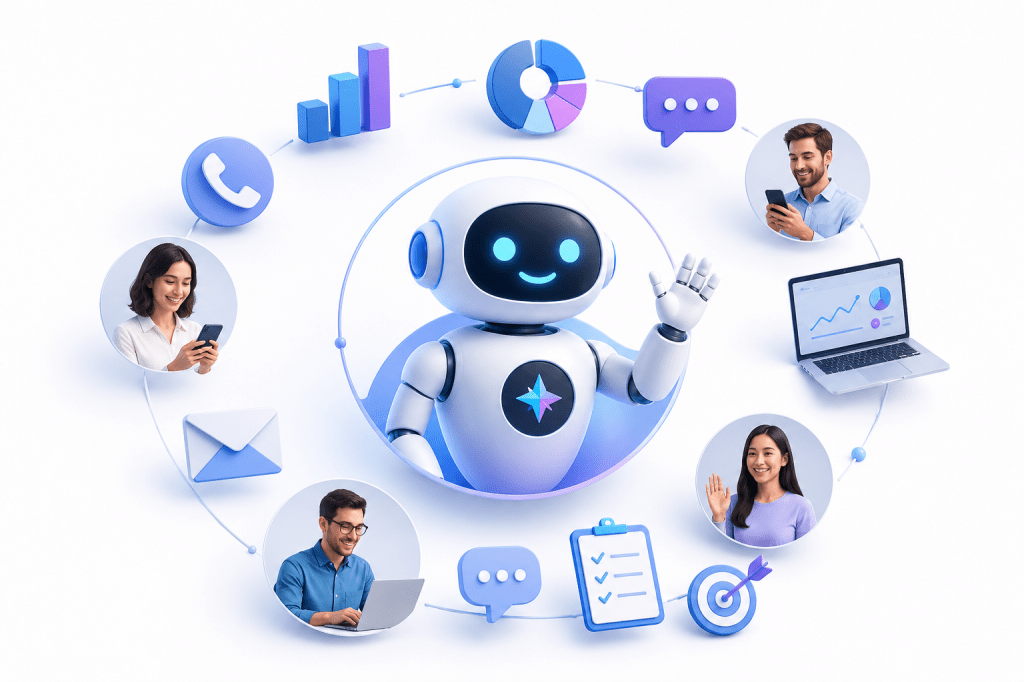
For years, companies treated websites as passive assets. A website was expected to “present information,” collect a contact form, maybe answer a few basic questions through a chatbot, and wait for a human sales or support team to continue the conversation later.
That model is starting to break down. Today, customers expect immediate interaction, immediate answers, and immediate guidance. They do not want to wait hours for a response, search through menus, or fill out forms that disappear into a queue. At the same time, businesses are overwhelmed by growing communication volume across websites, email, LinkedIn, Slack, forms, and messaging platforms.
This is one of the reasons why autonomous AI business agents are rapidly becoming one of the most demanded categories of AI tools in 2026. The shift is larger than simple automation. Businesses are no longer looking only for “chatbots.” They are looking for systems that can actively participate in communication, guide conversations, qualify opportunities, support customers, and help move business interactions forward without requiring constant human involvement.
This is exactly the direction in which BizDriver Nova was designed to evolve.
Traditional chatbots were usually reactive and limited. Most could only answer pre-written FAQ questions, provide scripted replies, redirect users to support pages, or collect basic contact information. But modern business communication has become much more dynamic. Potential customers often arrive with:
- complex questions,
- unclear goals,
- partially formed requests,
- urgent business needs,
- or industry-specific problems.
They expect interaction that feels intelligent, contextual, and helpful. BizDriver Nova was created to address exactly this challenge. Rather than acting as a simple scripted assistant, Nova functions more like an autonomous digital business concierge that can engage visitors in real time, guide conversations, understand intent, provide relevant information, suggest next steps, and route interactions toward meaningful business outcomes.
The difference is important. Instead of simply “responding,” Nova helps businesses actively manage and develop inbound engagement. The timing is not accidental, several major trends are converging simultaneously:
- traditional cold outreach response rates continue to decline,
- customers increasingly prefer self-directed digital interaction,
- businesses are expected to respond almost instantly,
- support and sales teams are overloaded,
- and AI adoption is accelerating across nearly every industry.
At the same time, websites themselves are becoming much more important operational environments. A company website is no longer just a digital brochure, it is becoming a communication layer, a qualification layer, a conversion layer, a customer guidance layer, and increasingly, an autonomous business interaction layer, and here AI agents like Nova become extremely valuable.
What BizDriver Nova Actually Does
BizDriver Nova is designed to autonomously engage with website visitors and support customer communication flows in real time. Depending on how a business configures Nova, the agent can:
- answer complex questions,
- guide users through services or products,
- qualify inbound opportunities,
- schedule meetings,
- recommend relevant resources,
- support onboarding flows,
- provide multilingual communication,
- route requests to the correct teams,
- and maintain continuity across conversations.
Importantly, Nova is not limited to static scripted logic. The system is designed to adapt interactions based on:
- conversation context,
- visitor intent,
- business priorities,
- organizational knowledge,
- and operational workflows.
This makes the experience feel significantly more natural and useful than traditional chatbot interactions.
Now, businesses are beginning to realize a bigger shift. One of the most interesting changes happening right now is that companies are starting to rethink the role of AI inside customer interaction itself. Initially, many organizations viewed AI mainly as:
- a productivity tool,
- a coding assistant,
- or an internal automation layer.
Now, AI is increasingly becoming customer-facing. That changes the business impact dramatically. AI agents are starting to influence customer experience, conversion rates, lead qualification, support scalability, response speed, operational efficiency, and even business development itself. In many ways, autonomous AI agents may become one of the defining operational technologies of the next several years.
At the same time, the future is not “AI Instead of Humans” as some may say. One misunderstanding that still appears frequently is the idea that AI agents are simply replacing people. In practice, the more realistic model is different. The companies seeing the strongest results are usually those where:
- AI handles repetitive communication layers,
- humans focus on judgment-heavy interactions,
- and both operate together inside a structured workflow.
That approach allows businesses to scale communication, reduce delays, improve responsiveness, and preserve human expertise where it matters most. AI agents like Nova are becoming valuable because they help companies manage growing interaction complexity more intelligently.
Why This Category Will Continue Growing
The demand for autonomous AI communication systems will likely continue growing rapidly because the underlying business pressures are increasing, not decreasing.
Businessess today face more inbound communication, more digital touchpoints, higher customer expectations, more fragmented attention, and stronger pressure to respond quickly and personally. Human teams alone often struggle to scale this efficiently. That creates a natural demand for AI systems capable of acting as intelligent operational communication layers.
This is why tools like BizDriver Nova are attracting increasing attention from businesses looking not only to automate tasks, but to redesign how digital customer interaction itself operates. The shift is already underway. The companies that adapt early may gain a significant advantage in responsiveness, engagement quality, and operational scalability over the next several years.
 BD&C - Business Development & Consulting
Leave a comment