
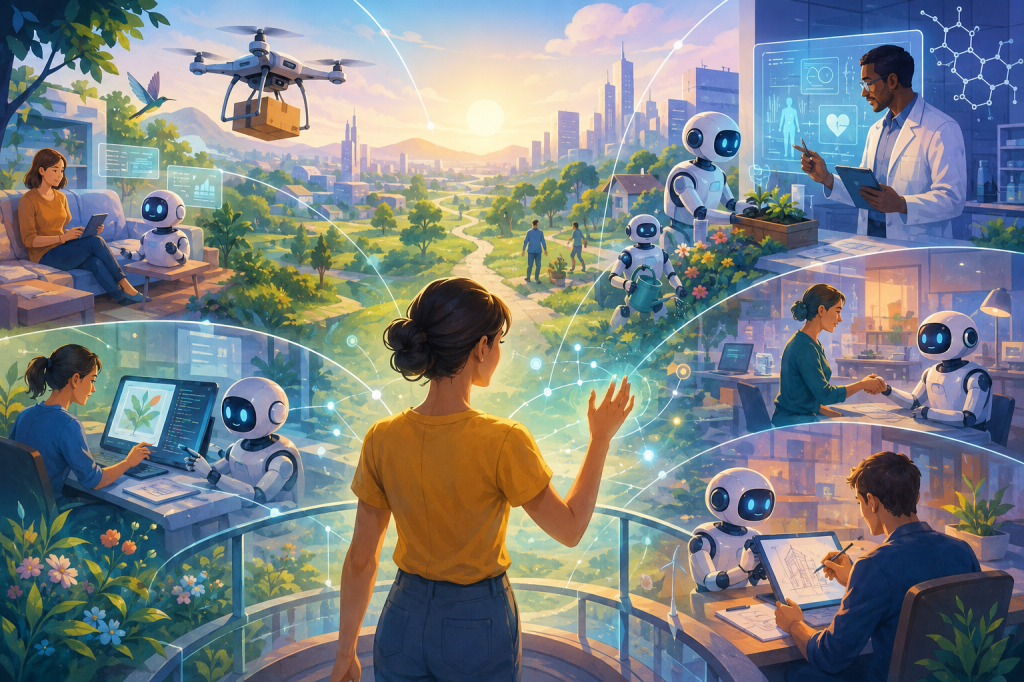
A few years ago, the idea of two AI systems talking to each other felt futuristic. Today, it is becoming normal.
Recently, I watched a video showing two AI agents communicating with each other to complete a task. No human typing. No person manually guiding every step. One agent understood the request, another processed information, decisions were made, actions were coordinated, and the task moved forward almost autonomously.
What struck me was not the technology itself. It was how quietly this transition is happening. Most people still think AI is something we “use” occasionally: a chatbot, a writing assistant, a recommendation engine, an image generator. But increasingly, AI is becoming something that works around us, between systems, behind interfaces, inside workflows, and soon, between businesses themselves.
Agents are no longer just tools. They are becoming participants in operations and society may not yet understand how large this shift actually is.
The Invisible Transition
Historically, every technological revolution visibly changed daily life.
Factories appeared.
Cars filled streets.
Computers entered offices.
Smartphones entered people’s hands.
This transition feels different because much of it is invisible.
An AI agent schedules meetings.
Another negotiates delivery times.
Another filters candidates.
Another analyzes contracts.
Another answers customer questions.
Another monitors infrastructure.
Another coordinates software deployment.
Sometimes people still supervise these systems, sometimes they only approve outcomes. And increasingly, people may simply define goals while agents organize the execution themselves. This changes the role of human work fundamentally.
From Doing Work to Orchestrating Work
Many professionals are beginning to experience something unusual: they are no longer spending most of their time performing tasks directly. Instead, they supervise, validate, correct, guide, coordinate, and orchestrate AI-generated work:
Developers review AI-written code.
Designers refine AI-generated visuals.
Managers coordinate AI-assisted workflows.
Analysts verify AI-produced insights.
Lawyers review AI-prepared documents.
Recruiters evaluate AI-screened candidates.
At first glance, this sounds wonderful: less repetitive work, faster execution, lower operational friction, more time for creativity, family, hobbies, learning, or rest. And honestly, in the short term, many people may experience exactly that. But longer-term consequences are much harder to predict.
What Happens When People Stop Practicing Their Skills?
Human competence depends heavily on repetition. Pilots train constantly.
Doctors continue practicing procedures. Engineers sharpen judgment through years of problem-solving. Writers improve through continuous writing.
Okay. But what happens when AI performs most operational tasks for years? A generation may emerge that understands processes conceptually but has far less hands-on experience than previous generations. This creates an unusual paradox: people may remain formally responsible for decisions while gradually losing the practical depth required to fully understand the systems they supervise.
Over time, humans risk becoming operationally dependent on systems they can no longer fully reproduce independently. And dependency changes power structures in ways societies rarely anticipate early enough.
The Psychological Shift Nobody Talks About
Work is not only about income. For many people, work provides:
- identity,
- routine,
- social belonging,
- purpose,
- self-worth,
- structure,
- measurable progress.
If AI agents gradually absorb large portions of operational and intellectual labor, society may face not only economic disruption, but psychological disruption. What happens when millions of people no longer feel “needed” in the traditional sense? What happens when human contribution becomes harder to define? Some people will adapt quickly and thrive in highly creative, strategic, or interpersonal roles, others may struggle with the loss of professional identity they spent decades building. This may become one of the largest social transitions of the century.
A New Inequality May Emerge
Another possible consequence is cognitive inequality. People who learn how to work with agents may become dramatically more productive than those who do not. A small number of individuals could suddenly manage workloads that previously required entire departments. One person with strong judgment and effective AI orchestration skills may outperform large traditional teams.
This creates enormous opportunity, but it may also accelerate concentration of wealth, influence, and decision-making power. Not everyone will transition at the same speed. And unlike previous industrial revolutions, this one affects not only manual labor, but highly educated knowledge work as well.
The Quiet Risk of Human Passivity
There is another subtle risk. Convenience changes behavior. GPS reduced people’s ability to navigate independently. Social media shortened attention spans. Recommendation algorithms changed how people discover information. AI agents may gradually reduce human initiative itself.
So, why learn deeply if an agent can explain? Why practice writing if an agent drafts everything? Why organize information manually if systems handle it automatically? At some point, efficiency can begin competing with human capability development. And societies built entirely around optimization may accidentally weaken resilience, adaptability, curiosity, and independent thinking.
But This Is Not a Story About Fear
Despite all these concerns, this transition is also extraordinary. AI agents may help humanity solve problems at scales previously impossible:
- medical research,
- infrastructure optimization,
- scientific discovery,
- accessibility,
- education,
- climate modeling,
- business creation,
- personalized learning,
- healthcare support.
The issue is not whether agents are coming. They already are. The real question is whether society will redesign education, work, governance, and human development thoughtfully enough to evolve alongside them. Because the future may not belong to people who compete against AI. It may belong to people who learn how to remain deeply human while working together with increasingly autonomous systems.
And we may be much closer to that future than most people realize.


Leave a Reply