
During my Soviet childhood, schoolchildren would chuckle as they repeated a little rhyme:
“What rare good fortune fate has brought: No need to give things our own thought.”
At the time, we barely understood how accurately those two lines described an unspoken social agreement. There was no internet or mobile communication. Soviet newspapers and a handful of television channels set the boundaries of our public understanding of the world. Day after day, we were told how to interpret events, whom to trust, what to take pride in, and whom to condemn. All available literature passed through ideological screening. Of course, people thought, questioned, read between the lines, and talked in their kitchens. But openly expressing an independent opinion could come at a high price.
In my memories, life was modest, marked by constant shortages, yet accompanied by a sense of predictability. If you followed the rules, demonstrated loyalty, and avoided unnecessary questions, the state would provide the essentials. Sometimes, a little more. You were not expected to understand how the system worked. You were expected to accept its explanations.
To borrow the language of programming, examining the “code” of everyday life was discouraged. In exchange for agreeing to run it without too many questions, you received your share of peace of mind. I remembered this while thinking over my discussion with Zachie Du Bruyn about cognitive debt in software development. The memory felt uncomfortably relevant to the present.
When Output Outpaces Understanding
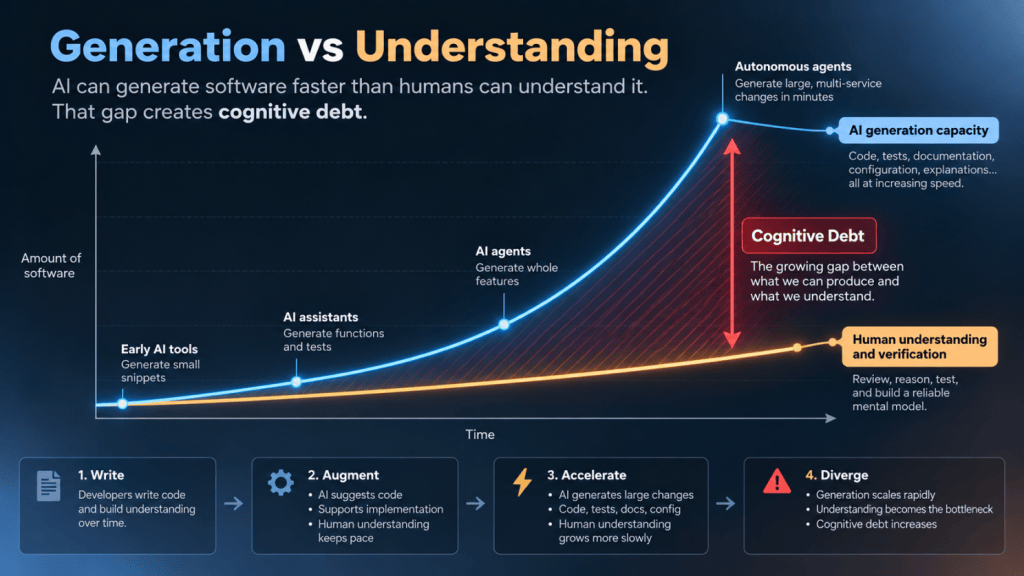
Zachie describes a problem that is easy to overlook amid the excitement about AI’s capabilities. Agents generate code faster than engineers can make sense of it. The software works, the tests pass, and the documentation looks convincing. But the team’s knowledge of the system does not necessarily grow alongside the volume of code produced. This creates cognitive debt: a company can operate a system while understanding less and less about how it works, why particular decisions were made, and what will happen when conditions change.
I find the Zachie’s observation about code review particularly accurate. Initially, an engineer asks: “Can I establish that this is correct?” Then, under the pressure of volume and time, the question changes: “Can I see anything obviously wrong?” The human is still involved. But the depth of that involvement has changed. This is where, to my mind, Zachie’s concern reaches far beyond programming.
Today, It Is Code. What About Tomorrow?
We face a similar choice whenever we receive a ready-made explanation instead of working through something ourselves. Why read a long text when you can get a summary? Why examine contradictions when you can ask for a conclusion? Why remember anything when the answer is always in your pocket?
In each individual case, this may be a sensible way to save time. I work with AI constantly myself, and I understand the value of that assistance. What concerns me is the point at which saving effort becomes abandoning effort altogether. You can read a book summary and decide you have understood its argument. Receive an analytical report without noticing which assumptions shaped its conclusions. Prepare a presentation in which every sentence sounds convincing, yet be unable to answer the first unexpected question. Outwardly, the work is complete. Internally, understanding may never have developed.
For programmers, this gap is particularly visible: there is code, there is its behaviour, and there is a failure whose causes someone will have to investigate. In everyday life, a lack of understanding can remain hidden much longer. We can repeat the right words, make decisions, and even appear competent until the situation moves beyond the ready-made answer.
An Old Feeling in a New Form
I am not equating AI with the Soviet state system, but I recognize a familiar human temptation: the relief of knowing that someone has already explained everything, so you no longer have to work it out yourself. During my childhood, independent thinking was restricted from the outside. Today, we may voluntarily give it up for convenience.
Nobody forbids us from opening the original source. Nobody prevents us from comparing explanations, checking arguments, or asking an uncomfortable question. All of that simply takes time, while a ready-made answer appears in seconds. And so we are tempted to mistake confidence for accuracy, and our own agreement for understanding.
This dependence can develop gradually, through countless harmless-looking decisions: not reading today, not checking tomorrow, not attempting to understand things independently the day after. It is precisely this willingness that troubles me. We may stop exercising our intellectual freedom long before anyone tries to restrict it.
Knowledge on Your Phone Is Not Yet Knowledge in Your Mind
Many years of my life have been connected with education. That makes it particularly difficult for me to accept the idea that access to information makes learning unnecessary. Yes, we no longer need to remember every date, formula, or instruction. But to ask a good question, we need at least some understanding of the subject. To notice a contradiction, we need something to compare the answer against. To assess a recommendation, we need to understand its conditions and consequences. Without knowledge of our own, it is difficult even to recognize when an explanation is wrong.
Learning gives us more than a collection of facts. Solving a problem teaches us to hold several conditions in mind at once. Reading a complex text teaches us to follow an argument. Comparing sources teaches us to distinguish fact from assumption and interpretation. Making mistakes teaches us to reconsider our conclusions.
If we continually skip this work in favor of a finished result, where will we develop these abilities? This question is especially important for people who are still learning. An experienced professional can check an AI response against knowledge accumulated over years of practice. A beginner has yet to build that foundation. We therefore need to think not only about how AI helps us do today’s work, but also about how tomorrow’s professionals will develop alongside it.
Understanding Really Could Become Scarce
Zachie suggests that human understanding may become a scarce resource. I see this as a warning for a much wider audience. Texts, reports, software code, and recommendations are becoming increasingly accessible. But having a result tells us nothing about whether a person can explain its foundations and limitations.
It is entirely possible to imagine a society with an abundance of polished answers and too few people capable of checking them. I do not consider this outcome inevitable. But the danger deserves attention now. Cognitive debt in software development can be seen as an early warning: our ability to produce results can outpace our ability to manage them with understanding. If we extend this problem to education, management, business, and everyday decisions, the cost of that gap becomes considerably greater.
What We Should Keep in Human Hands
When it comes to software development, I fully agree with Zachie: we need working conditions that allow engineers to exercise meaningful control over AI-generated code. Small, understandable changes. Time for substantive review. Explicit assumptions. Tests that demonstrate specific properties of the system. Up-to-date documentation. Responsibility that a person can accept because they understand the result.
Sometimes, this means moving more slowly than generation allows. That difference in speed needs to be reflected in how work is planned. Producing an implementation quickly and taking confident ownership of it are two different tasks. A team needs time for both.
In my own work with AI, I would like to follow a similar principle: use it in ways that leave me understanding more afterwards. Ask it to explain the reasoning behind a conclusion. Look for weaknesses in a proposed solution. Compare alternatives. Return to original sources. Sometimes, try to solve a problem independently before discussing it with AI. And ask myself a simple question: “Could I explain this to another person in my own words and respond to their objections?”
Hold On to the Habit of Thinking
I am glad Zachie brought up the topic. I would like it to be read not only by developers, but also by managers, educators, and parents – everyone who is discovering, with relief, how much intellectual work can now be handed over to a machine. I share that relief. But I also remember how easily peace of mind can coexist with the habit of accepting a ready-made picture of the world. That is why the old school rhyme no longer sounds funny to me.
“You don’t have to think for yourself” is too high a price to pay for convenience. Let AI help us read, investigate, create, and verify. And let us hold on to the work of understanding, even when a ready-made answer has already appeared on the screen.
#CognitiveDebt #SoftwareEngineering #CriticalThinking #ArtificialIntelligence
Originally published on LinkedIn on October 15, 2026.


Leave a Reply